
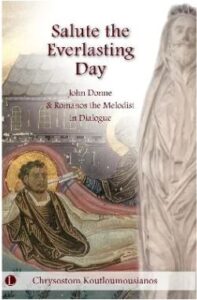
Title: Salute the Everlasting Day: John Donne and Romanos the Melodist in Dialogue, by Chrysostom Koutloumousianos
Published by: Lutterworth Press (2025)
Language: English
ISBN: 0718898281 / 978-0718898281
Pages: 251
In Rev. Dr. Chrysostom Koutloumousianos’s Salute the Everlasting Day: John Donne and Romanos the Melodist in Dialogue, the poet, the prophet, and we the readers all coalesce, joined in time and space by the power of poetic language to communicate “that which is essentially ineffable,” God’s presence. The book states in unambiguous terms that poetry and theology are conjoined: “the Church Fathers were also poets” (16) and, as one of the two protagonists of the book, seventeenth-century poet and Anglican preacher, John Donne, says, poetry is God’s chosen language to speak to us, as “The Holy Ghost communicates to man through metaphor and figurative language” (21). Poetry, the author strongly affirms, is not about private, individual feelings, but, inviting universal participation, “must flesh out, or more accurately, extract and articulate the beauty of theology, the beauty of speaking about God and to God” (20), who is both “the ultimate Poet (198)” and (in) the words that we read.
The book shows the same dislike for hierarchy that Father Koutloumousianous’s readers will remember from his previous work, The One and the Three. All of us, through baptism, repentance, kenosis, participation in the church’s sacraments, through following Christ’s commandments become the poets, prophets, and episkopoi of our own lives. While Koutloumousianous writes about two canonical figures, one from the Anglican West, John Donne, and one from the Orthodox East, fifth-century Greek hymnographer, Romanos the Melodist, the author’s definitions of poet and prophet are both narrow and infinitely capacious. In the narrow definition, poets and prophets are those whose words we hear, speak, and allow to transform us because, rooted in contemplative or liturgical tradition, they lead us to understand the Truth. And here, both Donne and the Greek hymnographer agree that the Truth is our awareness that “man is a future creature,” in Donne’s definition, or, as Romanos puts it, “our identity comes from our glorious end” (5). Being a future creature means that “we become whole and perfect, fully present, body, soul and faculties, at the final resurrection,” Donne claims (35), whereas Romanos adds that “even now, in secret, we are drawn into God’s fire – the fire that will make us whole, perfect, eternal” (49). In the infinitely capacious definition, “a[ny] sensitive human being is a true poet” and we are all called to be “sensitive” hearts and bodies attuned to “thin places” “of tremendous energy” in which we sense that God’s continuous presence binds synchrony and diachrony and become aware that the eschaton, the Last Things, is not merely the end of linear history (213). What true poetry does is remind us that Christ’s nature is in us, that we encounter Him in words, in the liturgy, in the eucharist, in the depths of our being, that He is so fully present that “our ordinary life carries a heavenly message. In some way, every moment is extraordinary,” as Donne puts it, and “even this extraordinary normality can be shattered by real, divine, unspeakable encounters” (17), a foretaste of something unthinkably better to come.
The book crosses interdisciplinary boundaries in an engaging, rather than ostentatious, display of erudition, which is hidden in ascetic footnotes. (Donne’s sermons alone are ten volumes.) Literary historians will not find the expected interpretations of Donne’s poetry or biography but will recognize the truth of the book’s portrayal of Donne’s endeavor to become “a future creature.” Theologians will recognize in the four parts of the book the trajectory of the human ascent to Christ from repentance to theosis. They will be left to ponder the truth of the claim that, while transformation is a priest’s “deepest purpose,” when guided by the Spirit, he expresses God’s will “in rhythmic feet and poetic figures” (198–99).
And the transformation of readers through words which, the more poetic they are the more deeply theological, is precisely what the book aims to achieve, as it teases out of the core of hymns, divine sonnets, and sermons an intimate and poetic dialogue between the two poets, a dialogue designed to shed light on our relationship with God, on the extent to which God makes Himself visible to us, to our naked hearts and physical eyes, and on what we can say that we see when we see Him or His light. In the imaginary conversation between Donne and Romanos the Melodist, the author offers his way out of the “hermeneutics of suspicion” by creating such an engaging intimacy that we might forget that he is present until he intervenes to expound and commend, modelling a graceful approach to analysis which seamlessly weaves the truth of the poets’ theology into the cloth of truth spun by the church tradition and illuminating the whole with the wisdom of lived experience. And here we realize that reading/hearing/seeing the words of the poets/prophets is not designed to be an intellectual spectator sport, as if we are to some degree what some of us profess to be, lovers of God, the words draw us into a true intimacy with Christ, with the three poets/prophets, and with our true selves. Which is to say: we are invited to read this book at our own risk, at the risk of seeing our “socially contrived, fragmented personas” exposed for the illusions they are and melt away, at the risk of finding ourselves enlarged and transformed and pondering for the rest of our lives Donne’s unflinching proclamation: “Heaven is here” (162), a statement on which the book is built.
The book is part of a larger contemporary conversation on the connections between literature and theology, spearheaded in part by ordained figures, such as Alison Milbank and Rowan Williams. It is especially Rowan Williams’ work to which I think this book is the perfect counterpoint. If Williams is Looking East in Winter to rediscover the Orthodox theology of the Philokalia and bringing stirring questions on the connection between God and language into sharp relief in The Edge of Words, in his turn, Rev. Dr. Koutloumousianos does not merely look back West but finds the underlying theological unity of two canonical figures and traditions.
Since the author creates a loving dialogue between a Greek Orthodox hymnographer and an Anglican poet and preacher and does not hide his own admiration for Donne, it is clear that the fervor of the love of God, the experience of God, and a grounding in patristic texts overcome doctrinal roadblocks to understanding the nature of our participation in God’s activities. While deeply grounded in the Greek tradition, the book suggests that it is neither doctrinal denominations, nor the sharp edges of nations, but rather our narcissism, our love of money and lust for power that keep us apart and prevent us from seeking, seeing, and “becoming God by putting on God” (108). And the message is clear: “[i]f we do not see God here, we shall not see Him hereafter” (190).
I would like to end this review with just one observation and one question. First off, lest a theologically-minded reader anticipate that reading this book entails broadening one’s horizons by sitting contentedly and engaging with feet and rhymes on a safely-sized printed page, the extremely powerful final chapter on prophecy throws the adventurers off the edge of words and into the abyss, so to speak. While the few—canonical preachers, prophets, and poets—stand out because they bring the many to God, the many—the prophets of their own lives—are not merely acted upon but agents in an interconnected universe: “Breaths, speech, life, eternal life, all are connected closely and inextricably. It is as if strings unite the whole world, indeed the created with the uncreated, so that every act reverberates across the universe” (205). Language goes beyond language: it is not only the visible words of this review that constitute a string which, “plucked” here below, causes “vibrations” to “soar at the top,” but so do all the thoughts, deeds, gestures, and actions that I may try to set aside in order to be “neutral” in front of my computer. There is no such thing as neutrality, the book warns us. Between the poieis of God and the poieis of the creature, words appear as both medium and the tip of the iceberg.
Second, the book points out that both prophecy and poetry have the same “radical force to force us beyond, outside, or maybe against our world, ourselves” (202), and to restore our sight. If we choose to have our sight restored, we will be able to sense that the face that we long to see is already looking at us and the infinite love that we crave is in response to God’s desire, “God’s pothos towards His own creature (194).” Secular authors can surely force us outside of ourselves: can they also communicate God’s presence?
Ioana Patuleanu
Mercer County Community College