
 Seventh International Colloquium on St. Maximus the Confessor
“St. Maximus the Confessor: The Salvation of Nature”
Warsaw, April 27-29, 2026
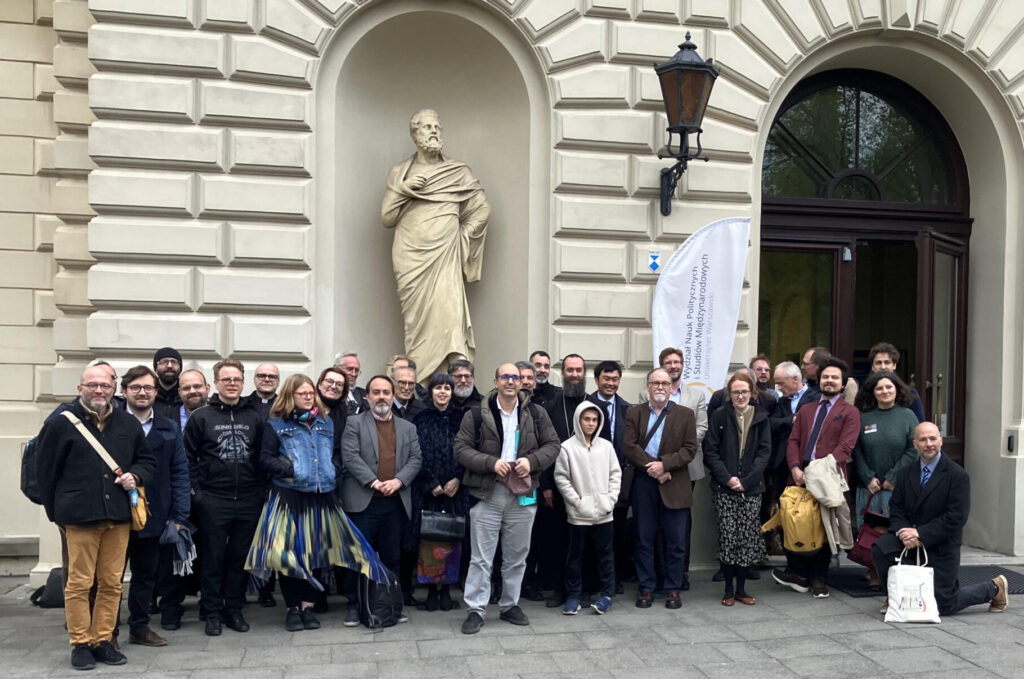
The 7th International Colloquium on St. Maximus the Confessor was held at the University of Warsaw, Poland, from April 27–29, 2026, with the theme “Maximus the Confessor: The Salvation of Nature.” The colloquium was a joint event organized by the University of Warsaw and the Centre for Development of Research and Education, in collaboration with the Institute for Philosophy and Social Theory (University of Belgrade) and the Faculty of Liberal Arts at Károli Gáspár University of the Protestant Church in Hungary (Budapest). The Organizing Committee, led by Karolina Kochańczyk-Bonińska and Bogna Kosmulska (Warsaw), with the assistance of Vladimir Cvetković (Belgrade) and Alex Leonas (Budapest), who also serve as the editors of the Subsidia Maximiana series, one of the principal publication series in the field of Maximian studies, brought together leading scholars to delve into the meaning of nature and its salvation in the thought of the Confessor.
Gathering approximately fifty participants from Europe, North America, and beyond, the colloquium continued a well-established series of international gatherings devoted to the study of one of the most influential theologians and Fathers of the Church. Alongside established scholars, it welcomed a substantial number of younger researchers, including doctoral candidates, whose participation demonstrated the vitality of a new generation of Maximian studies. Thus, it offered both inspiration for emerging scholars and an opportunity for reflection and reassessment for senior researchers.
While contemporary readers may initially associate the theme of “the salvation of nature” with environmental theology, the colloquium approached the question in a much broader sense: for Maximus, physis denotes not merely the natural environment but the whole created order, encompassing humanity, the cosmos, and their common end in Christ. Accordingly, the discussions revolved around fundamental questions such as: “What exactly is the nature that is being saved?” and “How does nature attain its fulfilment in God without ceasing to be itself?”
The papers addressed these questions from multiple perspectives, ranging from the doctrine of creation and the Fall to deification, cosmology, eschatology, natural law, and theological anthropology, together illustrating how, in Maximian thought, the salvation of nature concerns not only individual human beings but the transfiguration of creation as a whole. One of the most notable features of the colloquium was the breadth of perspectives brought to bear on a common set of questions. Close textual analysis, philosophical inquiry, historical theology, comparative studies, and contemporary theological reflection were all well represented.
The thematic arc of the colloquium was framed by two keynote lectures. Claudio Moreschini’s opening address on human nature before and after the Fall established the conference’s anthropological point of departure, while Pascal Mueller-Jourdan’s concluding lecture on St Maximus’s geometrical language and cosmological frameworks brought the discussions to a fitting close.
A significant cluster of papers examined the relation between creation, human nature, and the Fall, and revisited foundational themes in Maximus’s anthropology and cosmology, exploring the original vocation of the human being and the consequences of its estrangement from God. A second major thematic area concerned deification and the transformation of created beings. Here several papers engaged some of the most characteristic aspects of Maximian thought, including the distinction between natural and gnomic will, the role of contemplation (theoria), the significance of the logoi of creation, and the participation of creatures in divine life. As a common feature, many presentations portrayed deification not as an escape from nature but as its fulfilment.
The cosmological dimensions of salvation constituted another prominent thread running through the program. Numerous papers examined the relationship between humanity and the wider created order, the place of the cosmos in the plan of divine economy, and the eschatological purpose of creation. The recurring appearance of themes such as cosmic mediation, universal restoration, natural contemplation, and the transformation of the material world demonstrated the extent to which contemporary scholars increasingly recognize the cosmological scope of St. Maximus’s vision. Rather than restricting salvation to the individual soul, many presentations highlighted the Confessor’s account of creation as a unified reality called to participate in divine life.
Several presentations revisited questions often regarded as settled by previous generations of scholars. Particularly noteworthy were renewed discussions concerning, for instance, the alleged simultaneity of the events of the creation and fall of humanity, centered on the interpretation of Maximus’s enigmatic expression hama tō genesthai, and Gregory of Nyssa’s doctrine of apokatastasis. For the former, a range of counterarguments was advanced on textual, historical, and comparative grounds. For the latter, while many contemporary researchers continue to interpret Gregory as advocating a form of universal restoration, one presentation challenged this prevailing assumption by drawing upon Maximus’s reception of Gregory and proposing a different reading of the evidence.
Such exchanges illustrated the field’s continuing willingness to re-examine long-standing scholarly consensuses. The recurring interaction between specialists in Maximus the Confessor, Dionysius the Areopagite, and Gregory of Nyssa reflected the extent to which contemporary Maximian scholarship is intertwined with the study of both Dionysian and Nyssan traditions. Differences in theological and philosophical background occasionally became visible in discussions of analogy, participation, and deification. Scholars working within different academic and ecclesial traditions often approached these themes from distinct perspectives, contributing to a lively and productive exchange of interpretations.
The colloquium also displayed a noteworthy willingness to place St. Maximus in conversation with contemporary concerns. Several contributions explored the relevance of his thought for questions arising in modern theology and philosophy, including ecological responsibility, disability studies, metaphysics, and comparative religious inquiry. While not seeking to impose modern categories upon a seventh-century thinker, they demonstrated how Maximus’s theological synthesis continues to offer conceptual resources for addressing questions that remain pressing today. Thus, the resulting dialogue between historical scholarship and contemporary reflection was among the defining characteristics of the colloquium.
The colloquium also highlighted developments in the wider reception of Maximus. Participants noted the growing number of translations of Maximian texts into modern languages, making his works accessible to broader audiences. One particularly innovative feature of the colloquium was the presentation of a digital search engine dedicated to the works of St. Maximus, offering new possibilities for textual research and scholarly collaboration: http://theol.uni-sofia.bg/caspbl/tlmc/.
All in all, the Warsaw colloquium offered more than a series of specialized academic presentations. It provided a snapshot of the current state of research on St. Maximus the Confessor and demonstrated the continuing vitality of scholarship devoted to one of the most dynamic Fathers of the Church. The exploration of the salvation of nature from multiple perspectives illuminated the depth and complexity of Maximus’s vision of creation and its telos in Christ.
Beyond its academic program, the Warsaw colloquium featured an outstanding cultural and artistic program that complemented the scholarly sessions. All participants enjoyed remarkable hospitality, with activities that naturally extended scholarly conversations. They were introduced not only to the University of Warsaw, its historic campus and attractive surroundings, but also to the cultural and religious heritage of the Polish capital. Particularly memorable were the generous reception offered by Auxiliary Bishop Michael of the Catholic Archdiocese of Warsaw, whose warm welcome was greatly appreciated by the participants, as well as the visit to the Professor Kazimierz Michałowski Faras Gallery at the National Museum in Warsaw, featuring the celebrated wall paintings from the Cathedral of Faras (8th–14th centuries), one of the world’s most important collections of Christian Nubian art.
Evening gatherings and shared meals provided additional opportunities for scholarly conversation and collegial exchange in a spirit of friendship and scholarly fellowship. A particularly moving moment for the participants came during the concluding event at the Icon Museum of Warsaw, where a memorial service for the late Adam Cooper, and a moving word of remembrance by Paul Blowers, were held. An exclusive performance by the choir Katapetasma and the lavish farewell banquet with its generous array of traditional Polish dishes showcased the distinctive Polish virtue of hospitality and fostered an atmosphere of generosity and friendship. Another memorable artistic feature of the colloquium was a portrait of St. Maximus the Confessor specially prepared for the event by the father of one of the organizers, which served as a visual focal point throughout the conference, symbolizing the combination of scholarly rigor, ecclesial tradition, and personal dedication that sealed the gathering as a whole.
The international character of the colloquium was further reflected in the generous support provided by the International Orthodox Theological Association (IOTA), one of its principal sponsors, represented by its President, Paul Gavrilyuk, as well as by chairs of several IOTA committees. Founded in 2017, IOTA has developed into a global network of Christian, mostly Orthodox, scholars and professionals, dedicated to advancing theological research and fostering international scholarly collaboration. Through its Colloquia Program, IOTA supports academic events that promote dialogue between the academy and the Church, encourage high-quality research, and contribute to future publications.
It was announced that the 8th International Colloquium on St. Maximus the Confessor will be held in Georgia in January 2027, alongside the Third IOTA Mega-Conference.
Panagiotis Pavlos
University of Oslo